

When Amanda Nothstine first began to pursue a summer internship with Parents as Teachers National Center this year, she had no idea she was continuing a story that started two decades earlier.
A student in Saint Louis University’s Master of Public Health program, Amanda needed to complete an APEx – Applied Practical Experience – as one of her curriculum requirements. Many of the opportunities her classmates explored focused on epidemiology, but Amanda’s concentration lies in behavioral science and health equity. Her bachelor’s degree in journalism from the University of Missouri also factors into her ultimate career goals.
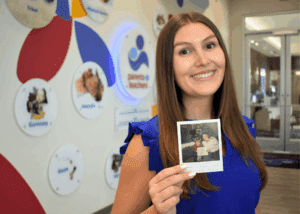 “I saw myself working in more of a health communication or health marketing field after graduation,” Amanda said. “So I wanted to pick something more in line with that.”
Advice from her assistantship professor led her to consider the Parents as Teachers National Center, the St. Louis headquarters of the largest evidence-based early childhood home visiting program in the US. He directed her to Erinn Miller, a recent graduate of SLU’s MPH program who interned with Parents as Teachers and now works in the organization’s Marketing & Communication department.
After reaching out to Erinn on LinkedIn, Amanda prepared for a meet and greet with key members of Erinn’s team. That’s when she updated her parents on her plans and learned something unexpected.
“You’re not going to remember this because you were tiny,” Amanda’s mother, Susan Nothstine, told her daughter, “but you are a direct product of the whole Parents as Teachers organization from the get-go.”
The Nothstine family lived in the Orchard Farm School District when Amanda was a child, and as a district communication practice, her parents received the school’s newsletter even before she was enrolled. Through the newsletter, they learned about Parents as Teachers and the opportunities offered. As a first-time parent, Susan was keen to receive the developmental input.
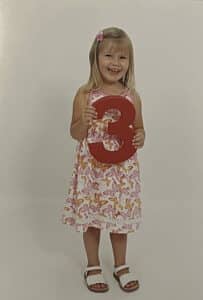 “These people could really help us,” she remembers thinking.
They soon met their parent educator, who dove right into the supporting role Susan had imagined.
“She was so open to questions,” Susan said, and the Nothstines took advantage of the opportunity to seek advice about Amanda’s milestones. When she wasn’t crawling at the same stage as a family member of similar age, it was their parent educator who reassured them that nothing was amiss.
“Everything she said just really put us at ease,” Susan said. And when Amanda skipped crawling in favor of walking, followed immediately by running, she assured them that this, too, was normal.
Other milestones in Amanda’s development were tracked during these home visits, as well.
“She would sit on the floor and play with Amanda,” Susan said, “but as she was playing, she was really filling out… the information to be able to give us feedback about Amanda’s personal social skills, fine motor adaptive skills, language skills, [and] gross motor skills.”
These developmental screenings are still one of the four program components that every family experiences within the Parents as Teachers model. Over 30,000 developmental or health concerns are detected by the organization every year (Parents as Teachers, 2025), opening the door to address them early. Intervention could include elements of the parent educator curriculum or connections to outside resources for specialized attention in an area. And studies show that “more than one-half of the Parents as Teachers children observed with developmental delays overcame these delays by age 3” (Parents as Teachers, 2022), illustrating the significance of identification and support.
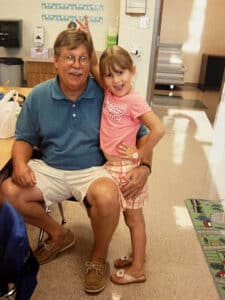 Another component of the Parents as Teachers model involves connecting families to a social network. Amanda’s dad, Fred Nothstine, retired early to care for Amanda during the workday, and he was the one who participated with her in the activities planned for families in the program. Typically held in a room at the Orchard Farm Elementary School – where Fred attended himself as a child and where Amanda would eventually enroll – the events provided an on-ramp for the family’s future engagement at school.
“That also did help familiarize us with the school again,” said Susan, “so that was good for when she went to school … that we weren’t complete strangers to the lay of the land.”
Evidence shows increased likelihood to volunteer in the classroom among Parents as Teachers parents (Parents as Teachers, 2024), an outcome shared by the Nothstines when Fred became a room dad for Amanda’s class.
“Being a room dad … is an experience I really treasure,” he said. He attended every class party, he said, and remembers being the only father volunteering in that way. “I think it was only room moms and me.”
It’s a ratio that isn’t unfamiliar in the program, even today. In fact, not long into her internship, Amanda set to work writing for a Parents as Teachers podcast episode on engaging fathers. They remain an underrepresented group among the program’s caregivers, and the podcast provided an opportunity to explore both the reasons why and some possible solutions.
 Her work on the subject led to a deeper consideration of her own experience and a meaningful conversation with her own father.
“We just kind of talked about what I was getting to write about and how I was glad that we were able to do those things together,” Amanda said. “And I’m more appreciative of it now. … So it was nice to get to reflect with him on that.”
Amanda has found in the internship an opportunity to return the investment Parents as Teachers made in her life.
“Now I’m able to kind of give that back to this organization,” she said.
Her work on the subject led to a deeper consideration of her own experience and a meaningful conversation with her own father.
“We just kind of talked about what I was getting to write about and how I was glad that we were able to do those things together,”
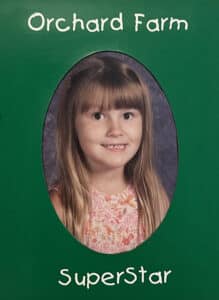
Amanda said. “And I’m more appreciative of it now. … So it was nice to get to reflect with him on that.”
Amanda has found in the internship an opportunity to return the investment Parents as Teachers made in her life.
“Now I’m able to kind of give that back to this organization,” she said.
She will finish her internship with a literature review examining substance use disorder and its implications for child development and caregiver wellbeing. When she ends her work with Parents as Teachers, she will begin her final year in the MPH program, graduating in 2026. Her dreams for her next stage of life are guided by a motivation shared by the organization that has weaved its way through her experiences in early childhood and now at the beginning of her adult career.
“I’m very passionate about helping people.”
Parents as Teachers. (2024, November). An Evidence-Based Home Visiting Model.
https://parentsasteachers.org/wp-content/uploads/2026/07/2026_EBHVM_Book_Digital_906.pdf
Parents as Teachers. (2022, August). Parents as Teachers’ Impact on Health.
https://parentsasteachers.org/wp-content/uploads/2022/08/PAT_Fact-S heet_ImpactOnHealth.pdf
Parents as Teachers. (2025). Research and Results.
https://parentsasteachers.org/research-and-results/