

Our Roots: A former parent educator remembers our earliest days
“I’ll never forget it.”
Parent educator Mary Caslin’s first home visit lives in her memory for good reason.
Originally a schoolteacher, Caslin had been recruited for a parent education initiative in the St. Louis region in 1981. Mildred Winter, another Missouri schoolteacher, designed and launched the program in response to a charge given by Missouri Commissioner of Education Arthur Mallory to improve school readiness among children in Missouri.
 “She was not afraid to try new things,” Caslin said of Winter, remembering how she championed the idea that developmental support and prevention should start far before others envisioned. At the time, most support centered around kindergarten as the key, but Winter saw a different path – one that Caslin would help create – in which the key to success began at birth.
Parent educators from four school districts in the St. Louis region dove into Winter’s four-year pilot program. A Harvard University consultant trained them in child development phases to set the stage for the learning and support they would offer local families. A key component involved personalized home visits, when parent educators like Caslin guided caregivers through the journey of parenthood, educating them on what to expect in each new phase of their child’s development.
And if parents were spared the feeling of laying the bricks of the path as they walked it, it’s because the parent educators bore that task; they personally created the home activity guides describing each developmental phase and the relevant parental expectations, and they created activities to support a child’s growth in that phase. As the families and children they met with developed, so, too, did the program’s resources – written, stage by stage, by Winter, Caslin and her colleagues.
By the end of Caslin’s time with the program, home visits had become second nature. She estimates that she conducted over 4,000 over the course of her 10-year career as a parent educator, but none of them were quite like the very first: all three of the parent educators in her district conducted the visit together, taking turns delivering the content to gain practice.
“I’ll never forget it,” Caslin said. She remembers feeling nervous but also understanding the significance of the event. “I think we all kind of knew that the program was going to be expanding,” she said, “and that that was kind of a special moment.”
In the 2024-2025 program year, Parents as Teachers conducted over 2 million of those personal visits with more than 189,000 families around the world. The story of growth spans four decades and crosses countries, and it begins with the success of that four-year pilot.
“After the first three years [of the pilot], it did show a difference,” Caslin said, “especially in the area of language.”
The success eventually led to a legislative mandate requiring parenting education in every Missouri school district and state funding to implement Parents as Teachers in that capacity. Less than a decade later, the initiative had become an official non-profit organization and expanded internationally.
The Parents as Teachers model now serves families worldwide, and forty years of evidence shows that language is just one of many areas where the program continues to make a difference, alongside child social development, safety, parenting knowledge and skills, family economic well-being, and more.
Personal visits remain a cornerstone of the evidence-based model. Together with their trusted parent educator, families discuss questions and concerns, celebrate milestones, and set goals for the future. The comprehensive, research-based, evidence-informed curriculum, created by a team of Parents as Teachers developers, still includes some of the same basic elements as the guides that Caslin wrote decades ago – elements like information about child development stages, what parents can expect, and activities to support their child’s growth.
Group connections, too, formed part of Caslin’s regular rhythm, and as one of the four pillars of the Parents as Teachers model today, they may be more crucial than ever before. As the US faces an “epidemic of loneliness,” these monthly events offer a thoughtful, cost-free antidote. Parents and children might share a meal, play a game, learn a skill, or visit a local site with others in the same stage of life. Because programs alleviate barriers like transportation and budget that may otherwise prevent families from this kind of engagement, group connections carve out a unique space that can be difficult to find elsewhere. In doing so, they pave the way for vital social capital that strengthens both parents’ and children’s capacity to move forward in the world.
Alongside these pillars stand two more: a resource network ensuring families can access every community support available, and health and development screenings, so that any concerns receive prompt identification and attention. Caslin remembers conducting annual hearing and vision screenings for the families on her caseload; currently, Parents as Teachers identifies approximately 32,000 health or developmental concerns every year. These also include speech and motor delays in children, timely scheduling for well child visits and immunizations, and depression and intimate partner violence in adults.
Reflecting on the work of Parents as Teachers in 2026, Caslin said, “You can’t imagine how much it fills my heart to see that the program still flourishes today.”
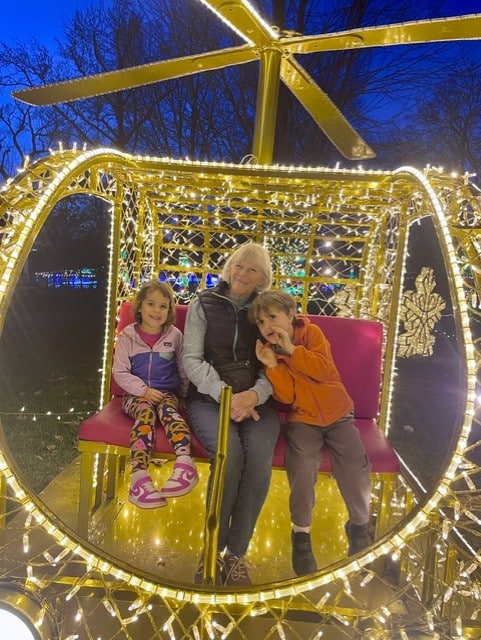
Her own time with the organization is a few decades behind her, but her time nurturing the next generation is still very much in the present. She’s dedicated this stage of her life to a very special family – her own. Caslin is a grandmother, and her role now revolves around her grandchildren, who undoubtedly benefit from their grandmother’s history creating spaces that give every child a strong start.